
Best Inverters for Van Life Under $300 (2026)
Quick Comparison
| Product | Price | Rating | Buy |
|---|---|---|---|
| Renogy 1000W Pure Sine Wave Inverter with ECO Mode (ASIN: B07VC5RTK7) | ~$120 | 4.5 ⭐ | Check Price → |
| Renogy 2000W Pure Sine Wave Inverter P2 (ASIN: B07H9SXV61) | ~$200 | 4.4 ⭐ | Check Price → |
| GIANDEL 2000W Power Inverter with Remote (ASIN: B07MMB23LS) | ~$210 | 4.2 ⭐ | Check Price → |
| GIANDEL 2000W Pure Sine Wave Inverter GFCI + USB-C 36W (ASIN: B0DPLWKS7L) | ~$255 | 4.3 ⭐ | Check Price → |
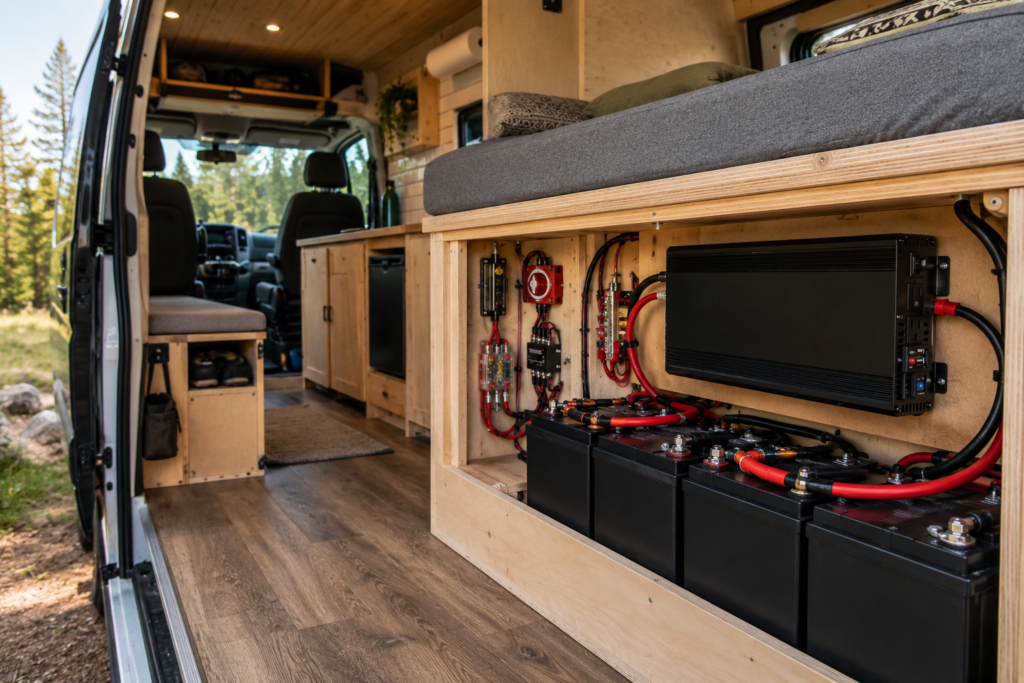
Your inverter converts 12V DC from your batteries into 120V AC — the kind of power that runs your laptop, blender, or CPAP machine.
Without one, you’re stuck charging through USB ports and cigarette lighter adapters. Fine for a weekend. Not a system.
The good news: under $300, you can get a quality pure sine wave inverter that handles most van life needs. These are the ones worth buying.
Quick Comparison
| Model | Wattage | Best For | Price Range |
|---|---|---|---|
| Renogy 1000W ECO Mode | 1000W / 2000W surge | Light builds, laptops + lights | ~$110–140 |
| Renogy 2000W P2 | 2000W / 4000W surge | Most full-time van builds | ~$180–220 |
| GIANDEL 2000W with Remote | 2000W / 4000W surge | Budget 2000W with remote control | ~$190–230 |
| GIANDEL 2000W GFCI + USB-C | 2000W / 4000W surge | Full-featured build under $300 | ~$240–270 |
(Prices fluctuate. Always verify current pricing before purchase.)
How to Choose
Pure Sine Wave Only
Modified sine wave inverters are cheaper. They’re also not worth it. Modified wave can damage sensitive electronics — laptops, CPAP machines, certain battery chargers. Every van should run pure sine wave. That’s not negotiable.
Size Your Inverter to Your Loads
Figure out what you’ll actually run at the same time. A laptop draws 45–90W. An induction cooktop pulls 1200–1800W. A CPAP is typically 30–60W. Add it up — that’s your peak draw. Size up by 20% to give the inverter headroom. Most van builds land between 1000W and 2000W.
Hardwire It
Clamp-to-battery or cigarette lighter connections are fine for a test run. For a real install, hardwire directly to your battery bank with the correct cable gauge. The inverter manual specifies what size. Don’t skip this — undersized wire is a fire risk.
Certifications Matter
Look for ETL or UL listing. It means the unit has been independently tested for safety. Most quality inverters in this price range have it — but double-check before buying a no-name unit.
Renogy 1000W Pure Sine Wave Inverter with ECO Mode
Best for: Minimalist builds and van lifers who don’t cook with AC power.
- ECO mode reduces power draw when loads are light — useful if you run your inverter 24/7
- Compact footprint, hardwire terminals, and a 5V/2.1A USB port built in
- Remote controller included — you can kill it from your bed
- 1000W won’t run an induction cooktop — if you ever plan to cook on AC, step up
- Some users report the fan runs louder than expected under sustained load
Renogy 2000W Pure Sine Wave Inverter P2
Best for: Most full-time van builds — enough headroom for induction cooking and a laptop at the same time.
- Renogy is one of the most trusted names in van life solar and power — parts and support are easy to find
- 3 AC outlets, hardwire terminals, 16ft remote switch included
- 4000W surge handles motor startups without a flinch
- No built-in battery monitor — you’ll need a separate shunt or BMS for that
- Heavier than the 1000W units; plan your mounting location accordingly
GIANDEL 2000W Power Inverter with Remote
Best for: Budget-focused builds that still need 2000W of capacity.
- ETL listed, meets UL 458 standard — not a no-name unit
- 15ft wired remote with LED display makes it easy to monitor from inside the van
- Full protection suite: over voltage, overload, under-voltage, overheating, short circuit
- Some users report the fan is louder than Renogy units at similar loads
- Build quality is solid but not quite at Renogy’s level — fine for most installs
GIANDEL 2000W with GFCI Outlets + USB-C 36W
Best for: Builders who want the most features under $300 in a single unit.
- GFCI outlets — required in some RV parks and a smart safety standard regardless
- 36W USB-C port handles fast charging for phones and tablets without a separate charger
- Battery monitor included on the remote — a real convenience in daily use
- Newer model — less long-term user data than the older GIANDEL line
- At ~$250+, you’re approaching the ceiling of the under-$300 category
Final Recommendation
If you’re running a minimal van build — laptop, phone charging, lights — the Renogy 1000W does the job cleanly.
If you want a full-featured daily driver that handles induction cooking: Renogy 2000W P2. It’s the safe choice — well-supported, reliable, proven in thousands of builds.
If you want the most features per dollar: GIANDEL 2000W GFCI.
The inverter isn’t the exciting part of a build. It’s infrastructure — and infrastructure should just work.