
Van Life Solar Setup for Beginners (2026 Guide)
This post may contain affiliate links. If you buy through them, we may earn a commission at no extra cost to you.
Last updated: March 2026
Solar sounds more complicated than it needs to be.
Most beginners picture a massive rooftop array, a confusing wiring diagram, and an expensive electrical build they have to get perfect on day one. That is usually not the real starting point.
Most van life beginners do not need a giant solar system right away. They need a practical way to replace part of their daily power use, reduce recharge stress, and stay stable when they are parked for longer stretches.
This van solar system guide is built for that stage. We are going to cover what a van life solar setup actually does, how much solar most people realistically need, and which beginner paths make sense without turning this into a deep electrical manual.
Think of it as a planning framework for a stable power system, not a badge of off-grid complexity.
What a Van Life Solar Setup Actually Does
A van life solar setup does not create unlimited power.
It helps replace part of the energy you use each day so your battery or power station does not stay empty for long. That distinction matters, because a lot of bad solar decisions start with the wrong expectation.
Solar is best understood as a refill system. It works while the sun is available, and the amount it replaces depends on panel size, weather, season, shade, and how your van is parked.
That means solar is not magic. It will not erase heavy daily power demand, and it will not make poor planning disappear. What it does do is reduce recharge stress.
When you are driving every day, alternator charging, shore power, or a simple power station recharge routine may carry more of the load. When you stay parked for longer periods, solar becomes much more valuable because it keeps the system working while the van sits still.
A solar setup does not create freedom by itself. It protects it.
The 4 Core Parts of a Basic Van Solar Setup
Solar Panels
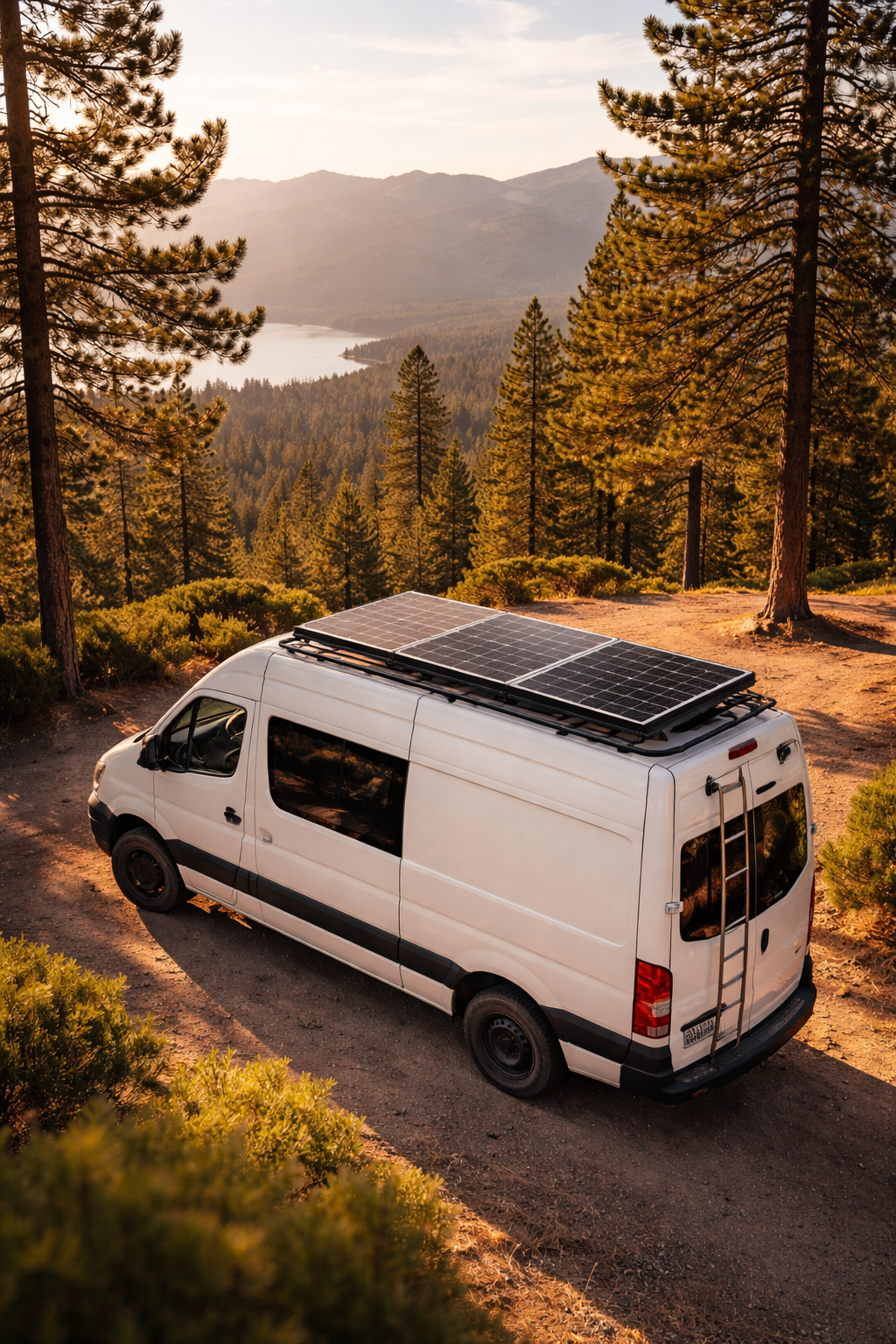
Solar panels collect sunlight and turn it into usable charging power. In a camper van solar setup, these are usually mounted on the roof or used as portable folding panels placed outside when parked.
More wattage usually means better recharge potential, but real output is always lower than the label in less-than-perfect conditions. Beginners do not need to memorize electrical formulas here. The main idea is simple: panels help refill what you use.
Charge Controller
The charge controller manages the power flowing from the panels into your battery system. Think of it as the traffic control layer that keeps charging safe and controlled.
If you are using a full DIY battery setup, the controller is a separate core component. If you are using portable solar with a power station, some of that control system may already be built in.
Battery or Power Station
Solar only helps if you have somewhere to store the energy. That storage is either a battery bank in a DIY build or a portable power station with integrated battery, ports, and charging controls.
Some people build a full electrical system with lithium batteries, inverter, fuse blocks, and dedicated wiring. Others start with a power station because it is simpler, cleaner, and safer for a first build.
Wiring and Mounting Hardware
This is the unglamorous part, but it matters. Wiring, fuses, connectors, roof brackets, cable glands, and mounting hardware are what make the system durable instead of temporary.
Beginners often budget for panels and forget the rest. A reliable solar setup for van life is not just the panel itself. It is the full path that gets charging power from the roof into storage without creating new problems.
How Much Solar Do Most Van Lifers Actually Need?
The easiest way to size a van life solar setup for beginners is to start with daily watt-hours, not panel fantasy.
If you have not estimated that yet, use this van life power needs guide first. Solar sizing gets much easier once daily usage is honest.
| Daily Power Use | Solar Recommendation |
|---|---|
| 200-400Wh/day | 100W-200W |
| 400-700Wh/day | 200W-300W |
| 700-1,000Wh/day | 300W-400W |
Weekend users often need less because the system can be recharged at home between trips and daily loads stay light.
Remote workers often need more because laptops, hotspot uptime, and longer parked sessions raise the daily baseline.
Once you add a 12V fridge, a laptop, and a hotspot, most people land in the 200W-300W range if they want a practical margin. That is why this tier is so common in real van life solar setup conversations.
It is also why beginners should stop asking only, “How much solar do I need for van life?” The better question is, “How much of my daily use do I want solar to replace with reasonable consistency?”
A Simple Beginner Solar Example
Here is a realistic daily-use example for a beginner van that includes the devices many people actually care about:
| Device | Rough Daily Usage |
|---|---|
| Laptop | 180Wh |
| 12V fridge | 400Wh |
| Lights | 30Wh |
| Hotspot | 40Wh |
| Fan | 60Wh |
| Total | 710Wh/day |
That is not an extreme setup. It is a very normal beginner stack for someone who wants food storage, basic comfort, and occasional or regular work sessions.
In a scenario like this, a 200W-300W solar setup is often enough for many beginner van builds, especially when paired with sensible battery capacity and realistic expectations. It will not produce the same output every day, but it can replace a meaningful part of that 710Wh daily use in good conditions.
Weather and parking position still matter. Cloud cover, tree shade, winter sun angles, and short daylight hours can all reduce recharge. That is why margin matters more than perfect math.
The 3 Best Solar Paths for Beginners
Path 1: Portable Solar + Small Power Station
A small portable setup is the easiest entry point because it avoids a full electrical build while still letting you learn your routine. Pairing a compact panel setup with the Jackery Explorer 300 Portable Power Station keeps the system simple and beginner-safe.
Best for: Weekend trips, light power use, and anyone who wants to test a solar setup for van life without committing to rooftop hardware immediately.
Limitation: This path is not ideal for fridge-heavy or remote-work-heavy routines. It is better as a low-demand starter than a long-term full-time solution.
Path 2: Mid-Range Portable Setup with Solar Input
This is the most balanced path for many people because it supports practical daily use without forcing a full DIY electrical system. The EcoFlow River 2 Pro Portable Power Station paired with a Renogy 200W Solar Kit gives beginners a workable middle ground.
Best for: Remote work, a 12V fridge, daily device charging, and beginners who want a camper van solar setup that still feels modular and manageable.
Limitation: It still depends heavily on conditions. If you stack multiple cloudy days or start adding heavier loads, the system can feel smaller than it looked on paper.
Path 3: Larger Expandable Setup
If you expect full-time use, longer parked stays, or heavier daily routines, a larger expandable path creates more breathing room. The EcoFlow Delta 2 Portable Power Station gives more storage flexibility, and a Renogy Solar Charge Controller becomes relevant when you move toward a more built-out solar system.
Best for: Full-time use, heavier daily loads, and people who want more expansion room instead of riding the edge every day.
Limitation: The cost rises fast. Larger systems are useful, but they can also pull beginners into overbuilding before they understand what they actually use.
Do You Need Solar Right Away?
No, not always.
If you drive daily, recharge often, and your power needs are light, you may be fine without solar at first. A power station plus regular charging opportunities can work well during the learning phase.
Solar becomes much more useful when you stay parked for longer stretches, run a fridge every day, or want less dependence on external charging stops.
That is why solar is often more about convenience and independence than pure necessity. It reduces friction. It buys time. It makes the rest of the system feel calmer.
Most Common Beginner Solar Mistakes
- Overbuilding too early
- Ignoring daily watt-hour usage
- Assuming solar works the same in all weather
- Forgetting mounting and wiring costs
- Not leaving margin
Best Starter Solar Direction
- Jackery Explorer 300 Portable Power Station – simplest low-demand path
- EcoFlow River 2 Pro Portable Power Station – best balance for most van life beginners
- Renogy 200W Solar Kit – strong starter panel size for many practical setups
FAQ: Van Life Solar Setup
How much solar do I need for van life?
Most beginners land somewhere between 100W and 300W depending on daily power use. Light weekend setups stay lower, while fridge and laptop routines usually push into the middle range.
Is 200W enough for van life?
Yes, 200W is enough for many beginner setups if your loads are moderate and you get decent sun. It is one of the most practical starting points for a van life solar setup for beginners.
Do I need solar if I already have a power station?
No. A power station can work without solar if you recharge by driving or shore power. Solar becomes valuable when you want longer parked stays and less recharge dependence.
Can solar run a 12V fridge?
Yes, but only if the overall system is sized realistically. A fridge is one of the main reasons people move beyond very small solar setups.
What’s the easiest solar setup for beginners?
The easiest path is usually portable solar paired with a power station. It keeps wiring simple and lets you learn your usage before building anything more complex.
Is solar worth it for weekend van trips?
Sometimes, but not always. If you mostly recharge at home and drive often, solar may be optional at first. It becomes more worthwhile when you want quieter, longer off-grid stops.
Do cloudy days ruin a van solar setup?
No, but they do reduce output, sometimes sharply. A good system expects imperfect weather and keeps enough battery margin to absorb weaker charging days.
Related Guides
- How much power you actually need in a van
- Real van life budget and startup costs
- Best 12V fridges for van life
- Best van life internet setup for remote work
- Van life gear starter kit
Final Thoughts
Solar does not need to be perfect to be useful.
Most beginners need a practical estimate, not an extreme build. The goal is to understand what solar can realistically replace and choose a system with enough margin to stay calm.
The point is not to build the most impressive rooftop system. The point is to reduce friction so the van works more easily day after day.